
MYT engineering selection notes
Self-Lubricating Bearings: Metal Composites, Graphite Bronze or Filament Wound?
Compare metal–PTFE composites, solid-lubricant plugged copper alloys and filament-wound bushings, including the lubrication limits of POM and bimetal designs.
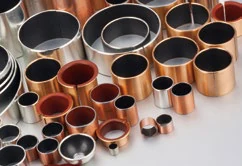
Identify the backing, sliding layer and lubrication
Metal composites, plugged bronze and filament-wound bearings are three construction routes. Examine the section and material list before comparing load, motion and mounting. Matching shaft diameters do not establish equal load capacity. These are sliding interfaces; rolling-bearing selection and life calculations cannot simply be transferred to them.
Make self-lubrication a series-specific requirement
Suitable metal–PTFE models can be assessed for dry running. Metal–POM marginally lubricated designs commonly need initial lubrication; bimetal designs require their specified oil or grease supply. Pockets and grooves are not graphite plugs. A bronze/PTFE description must identify whether PTFE is a lining, filler or another construction.
Describe load and speed through the duty cycle
Provide load direction, rotation or oscillation, speed, angle, starts and duty cycle. PV is pressure multiplied by sliding velocity; use the chosen series’ definitions and permitted conditions. Maximum pressure, speed and temperature taken from different catalogs are not a combined operating envelope.
Investigate the complete interface when replacing worn parts
Wear and seizure can involve shaft condition, clearance, installation, edge load or contamination. Include failure photographs and shaft/housing details, and agree prototype conditions and acceptance criteria. MYT can assess metal composites, bronze self-lubricating and filament-wound routes. Spherical plain bearings are a separate subseries, not interchangeable cylindrical bushings.
Three sliding-bearing constructions
| Family | Backing and sliding layer | First checks |
|---|---|---|
| Metal–PTFE composite | Metal backing, porous bronze and a PTFE-containing sliding layer | Model-specific lubrication, shaft finish and installed bore |
| Solid-lubricant plugged bronze | Copper-alloy body with solid-lubricant inserts | Alloy, inserts, motion and support conditions |
| Filament-wound composite | Continuous-fiber / resin backing and inner bearing layer | Resin, fibers, bearing layer and mounting instructions |
Lubrication constructions that are easily confused
| Name or appearance | Construction to establish |
|---|---|
| Metal–POM or bimetal | Initial grease, replenishment or continuous oil supply requirements |
| Bronze with holes, grooves or indents | Lubricant supply/storage features or actual solid-lubricant inserts |
| Oil-impregnated sintered bronze | Oil in a porous body, unlike solid-lubricant plugs; confirm supply separately |
Fill in the sliding duty for an inquiry
- Dimensions, length, flange and drawing revision: ____; shaft and housing: ____.
- Load / direction: ____; rotation, oscillation or linear motion: ____; speed / stroke: ____.
- Starts and operating time: ____; temperature, medium and contamination: ____.
- Shaft material, hardness and finish: ____; fits and allowable clearance: ____.
- Dry operation, no oil contamination or less maintenance: ____; current lubrication and failure: ____.
Selection questions
Is filament winding the same as an injection-molded plastic bushing?
Continuous-fiber wound backing differs from short-fiber-filled molded material. Check the resin, reinforcement and sliding layer rather than assigning one performance level to all plastics.
Can plugged bronze and metal composites be exchanged by size?
Dimensions are only a starting point. Recheck wall thickness, installation, shaft surface, operating clearance and lubrication mechanism.
Does oil-free mean that lubricant must never be added?
Follow the selected model and medium requirements. Designs allowing or requiring lubrication differ from those intended for dry operation; one rule does not cover the whole range.
Technical references and sources
These references explain construction principles and selection inputs. Confirm the MYT model, materials and operating limits against the actual application.
- GGB: Metal-Polymer Bearings
Supports the metal backing / porous bronze / polymer-layer construction, not transferable MYT ratings.
- GGB: DX lubricated metal–POM construction
A specific example of a grease-retaining POM layer and its lubrication requirements; the trademark is not a MYT designation.
- GGB: Fiber Reinforced Composite Bearings
Supports the relationship between continuous-fiber / resin backing and bearing lining.
- GGB: Metal and Bimetal Bearings
Distinguishes plugged, oil-impregnated sintered and grease-retaining designs; not all listed products are offered by MYT.