
ISO 9001:2015 Certified · Maiyu Tech (Beijing) Co., Ltd. (MYT) · Direct Engineering Desk
+86 139 1108 1857 yyang@myt-tech.cn
WhatsApp Live
Helen
Global Commercial & Export Desk
WhatsApp QR
📱 Scan with phone to chat
Launch WhatsApp →
🇬🇧 English
🇩🇪 Deutsch
🇫🇷 Français
🇪🇸 Español
🇨🇳 中文
Hostile Operating Environments

Extreme-Condition Transmission Solutions

Standard industrial components breakdown under heat, vacuum, acid, and heavy shock. We engineer application-specific motion packages combining Advanced Technical Ceramics, Tribo-Polymers, and Self-Lubricating Bushings.

Challenge 01

Thermal Extremes: -196°C to +800°C

The Failure Mechanism: At temperatures above 200°C, traditional oil and grease oxidize, carbonize, and cause catastrophic bearing seizure. At cryogenic temperatures (-196°C in liquid nitrogen/oxygen), lubricants freeze solid while standard steel becomes brittle and fractures.

The MYT Solution: We specify Hot-Isostatically Pressed (HIP) Silicon Nitride (Si3N4) and Zirconia (ZrO2) full ceramic bearings with thermal expansion compensation, paired with GGB-DB solid bronze graphite-plugged bushings. 100% maintenance-free, zero grease required.

  • Continuous thermal endurance up to 800°C (1,200°C peak)
  • Cryogenic non-brittle operation down to -196°C (Liquid N2)
  • Low thermal expansion coefficient (3.2 × 10⁻⁶/K) prevents clearance loss
Consult an Application Engineer →
High Temperature Industrial Kiln Roller Application
Challenge 02

Ultra-High Vacuum (UHV) & Cleanroom

The Failure Mechanism: In Ultra-High Vacuum chambers (below 10⁻⁷ Pa), volatile organic compounds from standard lubricants outgas, clouding optical lenses, causing cold welding between metals, and contaminating expensive silicon wafers during lithography or etching.

The MYT Solution: High-precision dry Silicon Nitride ceramic bearings equipped with custom PEEK or Torlon cages, or dry MoS2 (molybdenum disulfide) / DLC thin-film solid coatings. Guaranteed zero outgassing and particle generation compliant with ISO Class 3 cleanroom standards.

  • Vacuum rating down to 10⁻⁷ ~ 10⁻⁹ Pa (UHV)
  • Zero grease outgassing, particle emission < 0.1 μm
  • Non-magnetic permeability (μr < 1.0001) preventing sensor interference
Consult an Application Engineer →
Semiconductor wafer-handling equipment application illustration
Challenge 03

Severe Acid, Alkali & Seawater Corrosion

The Failure Mechanism: Chemical pumps, semiconductor scrubbers, and subsea robotics expose bearings to hydrochloric acid, hydrofluoric acid, chlorine, and salt spray. Standard 52100 bearing steel rusts in hours; even 440C stainless steel pits and fails prematurely.

The MYT Solution: Full Zirconia (ZrO2) or Silicon Carbide (SiC) technical ceramics combined with PVDF, PTFE, and SUS316L housings. Complete chemical inertness across pH 0 to 14, operating submerged in seawater or caustic washdown liquids indefinitely.

  • 1,000+ Hours ASTM B117 salt spray neutral corrosion testing with zero rust
  • Submerged operation in pool water, brine, and galvanic couples
  • Special labyrinth seal options to exclude sand, slurry, and grit
Consult an Application Engineer →
Chemical magnetic-drive pump bearing application illustration
Challenge 04

Heavy Shock Load & Inaccessible Zero-Maintenance

The Failure Mechanism: Oscillating pivot points in heavy industrial automation, subsea valves, and suspension linkages operate at high contact stresses. Lubricant is squeezed out of the contact zone, causing dry metal-on-metal galling and fretting corrosion.

The MYT Solution: Garmax® high-load continuous filament-wound composite bushings and GGB-DB cast bronze bushings embedded with solid graphite plugs. The self-lubricating transfer film continuously regenerates, sustaining dynamic loads up to 140 MPa without grease lines or downtime.

  • Extreme static load capacity up to 250 MPa, dynamic load up to 140 MPa
  • Eliminates hydraulic lubrication lines, reducing maintenance labor by 90%
  • Excellent dampening of high-frequency vibration and impact shocks
Consult an Application Engineer →
Pool-cleaning robot bearing application illustration
APPLICATION CONCEPTS

Home appliance and cleaning equipment bearings

Illustrative design directions for wet, detergent-exposed and debris-prone mechanisms. Confirm the exact material grade, geometry and operating envelope before specification.

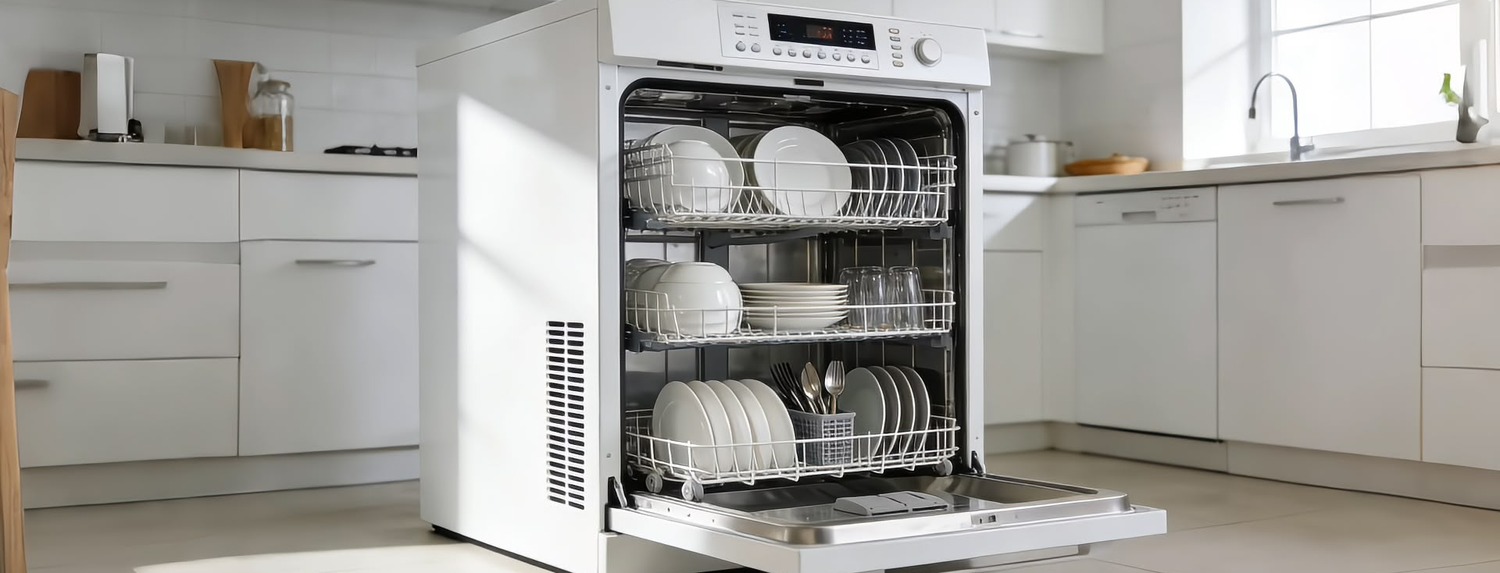
Dishwasher rack in a kitchen environment
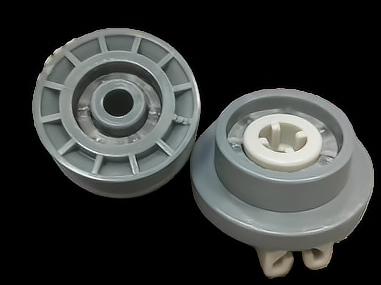
POM rack roller bearing concept
DISHWASHER · POM

Dishwasher rack roller bearing

Operating condition

Heat, humidity, detergent and food residue can challenge metal parts, lubrication and exposed rolling paths.

Design direction

Consider a POM engineering-plastic roller or bearing with an open, easy-to-clean structure. Final geometry and fit depend on the rack, load, speed and wash cycle.

-40 ~ +100 °CTypical continuous-use range
≈ 1.41 g/cm³Typical density
≈ 0.2% / 24 hTypical water absorption / 24 h

Review detergent compatibility, hot-water exposure, dimensional stability and cleaning access for the selected grade.

Discuss this application →
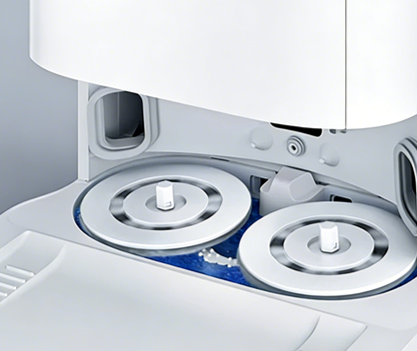
Robot vacuum cleaning base station
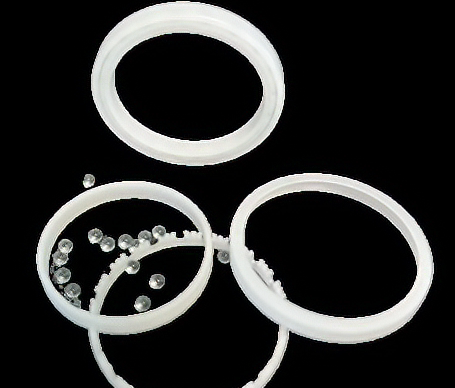
POM bearing and L-shaped seal concept
ROBOT VACUUM · POM

Robot vacuum base-station cleaning tray

Operating condition

Wastewater, cleaning agents, hair and fine debris may enter the rotating tray support and raise drag or maintenance needs.

Design direction

Consider a POM bearing with an L-shaped sealing feature to limit hair and debris ingress while retaining a low-friction running interface.

Engineering checks

Validate seal clearance, torque, chemical exposure and wear with the actual tray geometry and cleaning cycle.

Discuss this application →

Reference only: the POM figures shown are typical material-class values, not measurements of a specific bearing. Double-85, salt-spray and service-life results must be supported by reports for the selected product and test conditions.

Pool-cleaning robot underwater motor

The supplied concept also covers zirconia ceramic bearings with PEEK sealing for chlorinated water and sand exposure. This application already appears in our underwater robotics case section.

View the underwater robot case →

Ask by operating condition first

Selection starts with motion, load, temperature, media, installation and maintenance boundaries.

Extreme temperature / vacuum

State pressure, temperature, cleanliness, allowed materials and lubrication limits.

Corrosion / cleaning

Name the medium, concentration, exposure, cleaning agent and cycle; check each component separately.

High speed / insulation

Provide speed, load, insulation path, heat and noise limits; hybrid bearings still contain metal rings.

High load / oscillation

Provide peak load, angle, frequency, shock and edge loading; assess spherical and plain structures separately.

FAQ

Can a model be selected from shaft diameter alone?

Usually not. Diameter is one input; structure, load, speed, temperature, media, fits and acceptance conditions are also required.